Call us toll free:
+86 755 2306 6423
Shenzhen 3Mtek Innovation Technology Company Limited
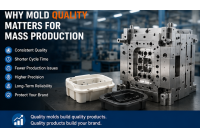
When customers think about injection molding, they often focus on the plastic material and the injection molding machine.
But there is another critical component:
The mold.
The mold is the foundation of the production process.
Every cycle depends on the mold opening, filling, cooling, and ejecting the part correctly.
When production reaches thousands or hundreds of thousands of pieces, small tooling problems can become large business problems.
Mass production requires repeatability.
The first part should meet the required specifications, but the 10,000th part also needs to meet those requirements.
A properly designed and manufactured mold helps maintain consistent product dimensions, appearance, and function.
This is especially important for products that require accurate assembly or have strict cosmetic requirements.
Cooling is one of the important factors in injection molding cycle time.
A suitable cooling system helps the molded part cool consistently before ejection.
If cooling is poorly designed, production may experience longer cycle times or inconsistent part behavior.
Even a small difference in cycle time can become significant when multiplied across large production quantities.
Production problems can come from many sources.
For example:
Flash
Short shots
Sink marks
Warpage
Ejection problems
Dimensional variation
Cosmetic defects
Not every defect is caused by the mold, but mold design and manufacturing quality can have a significant influence on production stability.
The mold cavity creates the shape of the final plastic part.
If critical areas of the mold are not manufactured accurately, the resulting product may not meet the required dimensions.
This is particularly important for products with:
Snap fits
Moving components
Assembly interfaces
Sealing surfaces
Threads
Precision dimensions
For these products, tooling accuracy is directly connected to product performance.
A mold should not only work during the first trial.
It should be capable of supporting the required production volume with appropriate maintenance.
This means mold construction, component selection, cooling, ejection, and moving mechanisms all need to be considered as part of the overall tooling strategy.
Your customer does not see the mold.
They see the product.
If inconsistent production creates visible defects, poor fit, or functional problems, the customer may associate those problems with the product brand—not the manufacturing supplier.
For this reason, tooling quality is ultimately part of product quality.
A mold can look impressive in photographs and still have important production issues.
Professional mold making involves much more than machining a cavity.
It includes engineering, material selection, tolerance control, cooling design, ejection, assembly, trial molding, inspection, and continuous improvement.
For a market-validated product moving into mass production, the mold represents more than a manufacturing expense.
It is an investment in the product's future production capability.
At 3MTEK INNOVATION, we approach tooling as part of the complete production process.
We review product requirements, develop the mold solution, conduct trial production, evaluate samples, and support the transition into stable production.
A reliable mass-production process starts with reliable tooling.