Call us toll free:
+86 755 2306 6423
Shenzhen 3Mtek Innovation Technology Company Limited
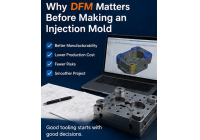
One of the most important stages of an injection molding project happens before the mold is made.
It is called DFM — Design for Manufacturing.
For businesses moving an existing 3D printed product into injection molding, DFM is especially important because a design that works well for 3D printing may not automatically be suitable for injection molding.
DFM is the process of reviewing a product design from a manufacturing perspective.
Instead of asking only:
"Does this product look right?"
DFM asks:
"Can this product be manufactured consistently, efficiently, and economically?"
A typical injection molding DFM review may examine wall thickness, draft angles, ribs, bosses, undercuts, parting lines, gate locations, ejection, material selection, shrinkage, and cosmetic requirements.
Industry guidance commonly identifies these areas as important factors in injection molding design because problems discovered after tooling can result in mold modifications, delays, or additional costs.
A mold is a significant investment.
Once steel is machined, changing the product geometry may require additional machining, inserts, welding, or even major mold modifications.
This is why it is much better to identify potential problems while the design is still digital.
A good DFM review can help answer questions such as:
Can the part be removed from the mold?
Where should the parting line be?
Does the product have enough draft?
Are the walls suitable for molding?
Could ribs or bosses create sink marks?
Where should the gate be located?
Are there undercuts that require special mechanisms?
Is the selected material appropriate?
Which surfaces require special cosmetic attention?
A useful DFM process should not simply produce a list of problems.
It should provide solutions.
For example, if a feature cannot be molded easily, there may be several options:
Option 1: Modify the product geometry.
Option 2: Change the mold structure.
Option 3: Use a different manufacturing approach.
Option 4: Keep the existing design and accept a specific manufacturing limitation.
The right solution depends on the product's function, appearance, volume, and cost requirements.
Product design has a direct influence on manufacturing cost.
A complicated product may require additional mold mechanisms, more complex machining, longer cycle times, or more difficult quality control.
Sometimes a small design adjustment can simplify the mold without changing the product's essential function.
This is one reason DFM should be considered an engineering and commercial discussion—not just a technical checklist.
A common mistake is to start mold manufacturing immediately after receiving a 3D CAD file.
A better process is:
CAD File → DFM Review → Design Improvements → Customer Approval → Mold Design → Tooling
This gives both sides an opportunity to identify and resolve important issues before money is invested in tooling.
The customer understands the product.
The manufacturer understands the production process.
The best results come when both sides work together.
At 3MTEK INNOVATION, we use the DFM stage to review the customer's existing product, identify potential molding issues, propose practical improvements, and confirm the final design with the customer before mold production begins.
The objective is not to change your product unnecessarily.
It is to make sure the product you have already validated can successfully become a production-ready molded product.
Good tooling starts with good decisions before the steel is cut.