Call us toll free:
+86 755 2306 6423
Shenzhen 3Mtek Innovation Technology Company Limited
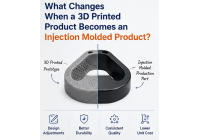
What Changes When a 3D Printed Product Becomes an Injection Molded Product?
You already have a product that works.
You have tested it with 3D printing. Customers have used it. Maybe you are already selling it.
Then you contact an injection molding manufacturer and hear:
"The product needs some design changes before we can make the mold."
This is one of the most common concerns when moving from 3D printing to injection molding.
Will the product look completely different?
Will the original design be lost?
Will the changes affect how customers use the product?
The answer is: not necessarily.
The purpose of DFM is not to redesign your product for the sake of changing it. The goal is to adapt the existing design so that it can be manufactured reliably through injection molding.
Why Does the Design Need to Change?
3D printing and injection molding use completely different manufacturing principles.
A 3D printer creates a part layer by layer. Injection molding fills a mold cavity with molten plastic and then cools the material.
Because of this difference, some features that are easy to print may be difficult or expensive to mold.
For example, an injection molded part may need:
These changes are manufacturing-driven rather than simply cosmetic.
The Goal Is to Preserve the Product
A good manufacturing partner should first understand the product.
What is the most important function?
Which dimensions are critical?
Which surfaces are visible?
How does the product connect with other components?
Which features are important to customers?
Once these questions are understood, the manufacturer can determine which changes are necessary and which features should remain unchanged.
In many cases, the overall appearance and user experience can remain very close to the original 3D printed product.
Some Changes Can Actually Improve the Product
The transition to injection molding can also be an opportunity to improve the product.
During DFM review, engineers may identify:
Instead of simply saying "this cannot be molded," an experienced manufacturer should explain the problem and propose practical alternatives.
Design Changes Should Be Discussed Before Tooling
One of the most important principles is simple:
Solve design problems before cutting steel.
Once a mold has been manufactured, major product changes can become much more expensive and time-consuming.
That is why DFM review should happen before mold manufacturing begins.
The customer and manufacturer can review proposed changes together, confirm what will change, and approve the final production design.
Your Product Should Still Be Your Product
Moving to injection molding does not mean handing your product over to a manufacturer and letting them redesign everything.
You remain the product owner.
The manufacturer's role is to help translate your existing product into a reliable manufacturing process.
At 3MTEK INNOVATION, our approach is to first understand the customer's existing product and requirements, then identify the changes required for injection molding, explain the reasons behind those changes, and work with the customer to confirm the final design before tooling.
The objective is simple:
Keep the product customers already like, while making it easier, more reliable, and more economical to manufacture at scale.